
The Lazy Boy That Held Me
And why the term "single mother" doesn't quite cut it

No one knows more about what it takes to raise a child than a single mother.
I was once told, “But you aren’t alone. True single moms do it alone. You have lots of support.” At the time, I did not want to hear that. I responded back by explaining that I was a woman raising a child in a home that doesn’t fit the so-called “traditional” shape of family.
Even that’s a silly thought. Because by traditional, I meant the “nuclear” family. The one sold to us in the West in the mid-20th century to sell more houses and kitchen appliances. The one that insisted women weren’t intelligent enough to have their own credit cards. That nuclear family.
I’d come to realize later that there’s nothing traditional about the nuclear family. The nuclear family is actually, quite new. I can deduce that my definition of village was shaped by western media: movies, commercials, books. Growing up in California, even though there were many phases of my childhood that involved living with extended family, I had a dream to find my person, fall in love, get married and have children. And girl, that is not what happened.
But here’s something about where I come from: I didn’t learn about the nuclear family from my own people. I learned it from sitcoms and paperback novels and the way America loves a picture-perfect front lawn no matter how overgrown the weeds are in the backyard. Where I come from, family has always been bigger.
Guåhan reinforces that family has aunties and cousins and godmothers and friends that are basically family. My people are collectivist in nature. CHamoru culture has always known that the weight of childrearing was meant to be distributed. My grandmother, my aunties, my cousins—they all grew children together. So when I think about it now, I realize that the dream of the nuclear family wasn’t even mine. It was sold to me and I bought it–or tried to. I thought I was grieving something I lost, but really I was grieving something I was never built for. (Sharp thought #1).
Now, there were other fractures that disrupted mine and my family’s sense of community growing up, which I alluded to in my first letter. So without retelling stories, it’s enough to say that they shaped the kind of love I went looking for, and the kind I thought I had to earn.
It took me two years after I split from my daughter, Lili’s, father to accept my circumstances. That my daughter and I would wake up in the mornings and fall asleep at night with just the two of us. Our home became quieter and more peaceful even, but I was still grieving this “dream.”
And there’s no one who knows more about what it takes to raise a child than a single mother, because it’s painfully clear when you’re doing it all yourself.
I’ve broken down in the middle of piles of laundry, half-week-old dishes in the sink, stacks of paper and objects blurring together in every surface of my living room— work forms, legal documents, art supplies, all bleeding into each other.
For a long time, shame told me I should be doing this by myself. That the burden was mine to carry for not choosing differently. That it was my duty to figure it out alone.
I can’t pinpoint exactly when that started to change, but slowly, I began letting my family and friends in. At first, it was just them giving me space to cry and to process.
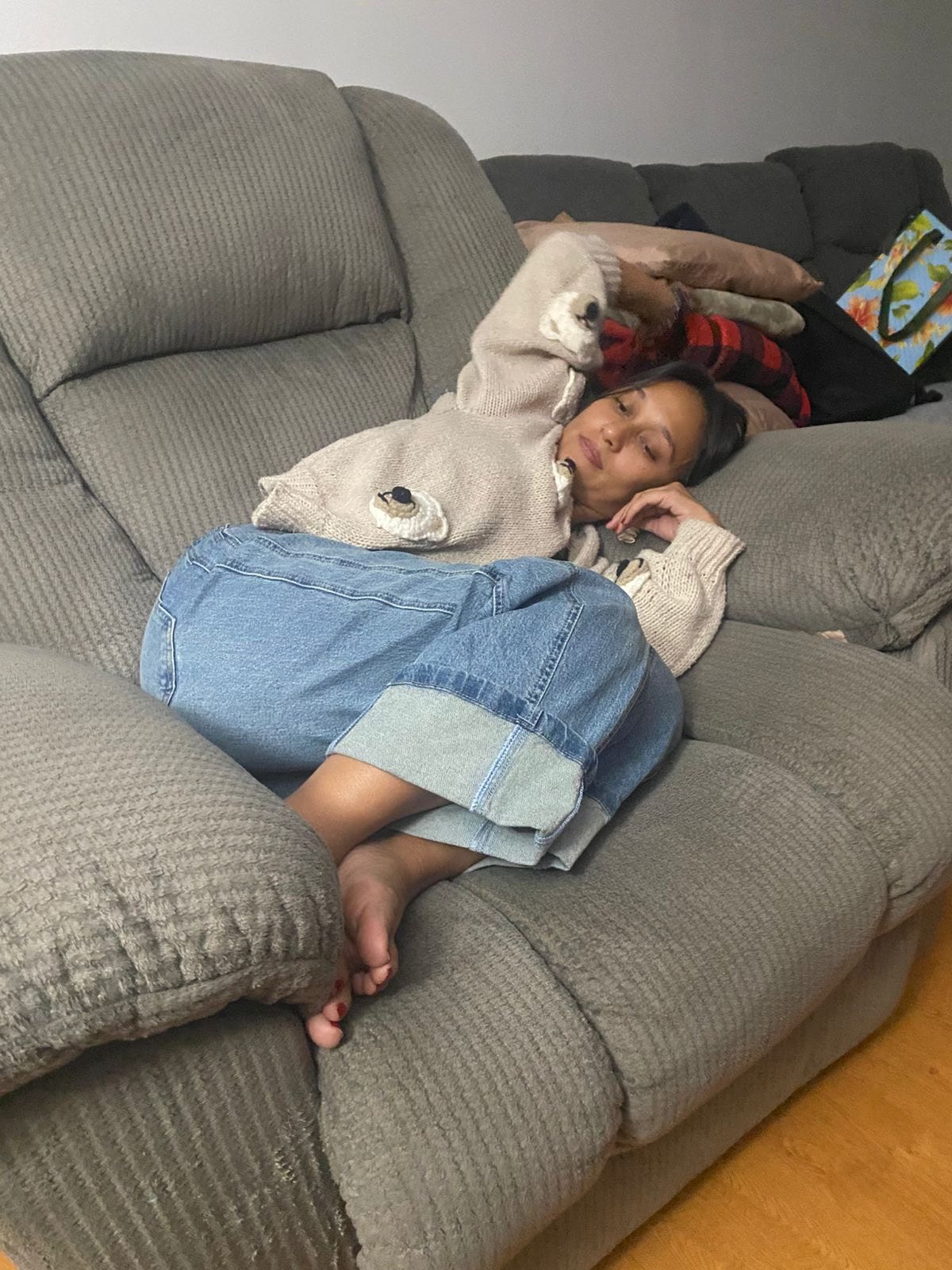
I remember a specific soft grey lazy boy at one of my best friend’s apartments that I slept in once or twice a week for nearly a year, whenever my daughter stayed with her dad’s family. I’d spend the night talking with friends, then pull the chair out a few inches from the wall, recline, and fall asleep—usually before they’d finished hanging out. I’d tuck my legs in on one side and lay my head over my hands on the other, like a little girl, cuddling up on her mother’s lap. It became a running joke that I could sleep through anything: shot glasses clinking, loud conversations, even scary movies, specifically that one with the nun.
What they didn’t know was that I wasn’t sleeping much the rest of the week. That most nights, I stayed up till three or four in the morning asking the quiet night how I ended up here. Even when I did manage to sleep, my body jolted awake hours later, flooded with cortisol.
Their presence soothed me so completely that I could fall asleep and stay asleep on that lazy boy until morning. That chair held me over until I could pick my daughter up and be a mom again.
That recliner was a sneak peek into the miraculous ways my village would materialize in the years that followed.
There was the time I was so broke I started offering songs on my Instagram stories in exchange for gas money. I called them morning coffee songs—raspy, first-thing-in-the-morning a cappella, for five, ten, sometimes twenty dollars. My friends sent requests and tips with laughing emojis and hearts.
The time my freshly postpartum sister in Napa wired me enough to hold Lili and me over for two months after a single phone call.
The time my mali—my daughter’s godmother—slipped an envelope into our Christmas gifts without me noticing. When I found it later at home, I sat on the floor against our pull-out sofa bed and sobbed.
The time I called my aunties, whom I hadn’t spoken to in years, and asked if they knew anyone willing to rent a place to me. It took them twenty-four hours.
The time my family showed up with boxes, a truck, and their strong backs, and moved me out of an apartment soaked in five years of grief—cracked bathroom tiles and all—in a single day. When I picked my daughter up to bring her to our new place, the whole family was there waiting. They wanted her to remember what home really is: wherever we are. They brought treats just in case.
None of this looks like what I thought family would, but I’m so glad. Because I’ve realized I was more isolated before my relationship ended. And here’s small sharp thought #2: some moms are lonelier than I am, even with someone in the bed next to them.
The nuclear family is a fallacy. No mom and no dad is meant to do all of this alone, even with each other.
I swear that recliner taught me something about real safety—the kind that doesn’t come from promises, but from presence. And my friend was right, I am so far from a single mom. There is nothing singular about mine or my daughter’s life.
Now, I can truly appreciate our day-to-day. Just the other evening, my daughter’s aunt called and said, “I have snacks for Lili. Where can I meet you?” So we drove home with Lili clutching her bag of dum-dums, and a tote full of animal crackers, bananas, and small kindnesses in the passenger seat.
Sometimes the village looks like this: like a bag of snacks at dusk, like a soft recliner, like a perfectly timed phone call, like 4 truck loads of furniture and heavy lifting, like being seen enough to know I’m not doing this alone.
And if you feel alone, look again: who has already been holding you? What does your village look like?
I know being the only physical parent within the four walls of your home is hard. In what ways is it obvious that family is bigger than you imagined? What are moments you can recall your sense of family spilling past those four walls?